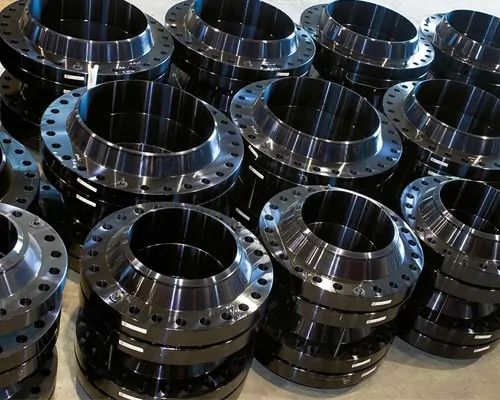
Flanges are the connectors that hold pipeline systems together — and choosing the wrong type or pressure class can result in costly leaks, process shutdowns, or safety incidents. Here is your complete reference guide to pipe flanges UAE, including types, pressure classes, facing types, materials, standards, and gasket selection. Whether you’re working on oil & gas, petrochemical, water, or infrastructure projects, this guide helps you select the right flange for your application.
What is a Pipe Flange?
A pipe flange is a disc-shaped mechanical fitting used to connect pipes, valves, pumps, and other equipment to form a piping system. Flanges provide a removable joint, allowing for easy assembly, maintenance, and inspection. They are bolted together with a gasket in between to create a seal that prevents leakage under pressure, temperature, and vibration.
Flanges work by aligning two pipe ends or equipment nozzles, clamping them with bolts, and compressing a gasket to form a tight seal. The flange face geometry, bolt pattern, and material determine its compatibility and performance.
Why standards matter: Flanges must conform to international standards like ASME B16.5, B16.47, and API 6A to ensure dimensional accuracy, pressure ratings, and interchangeability. Using non-standard or mismatched flanges can lead to misalignment, leaks, and failed inspections — especially critical in pipe flanges UAE projects where compliance with client and regulatory standards is mandatory.
Types of Flanges
There are several types of flanges, each designed for specific applications, pressure levels, and installation requirements:
1. Weld Neck Flange
Features a long tapered hub that is butt-welded to the pipe. Ideal for high-pressure, high-temperature, or critical service applications. The weld neck distributes stress and reduces turbulence, making it the preferred choice for oil & gas and refinery pipelines.
2. Slip-On Flange
Slips over the pipe and is welded on both the inside and outside. Easier to align than weld neck and less expensive, but not as strong. Commonly used for low-to-medium pressure applications.
3. Blind Flange
Has no bore and is used to close off the end of a piping system or vessel. Blind flanges withstand high pressure and are used for future expansion, testing, or isolation points.
4. Socket Weld Flange
The pipe is inserted into a socket and welded on the outside. Used for small-bore, high-pressure piping. Provides good strength but is not suitable for corrosive services where crevice corrosion may occur.
5. Threaded Flange
Has internal threads that screw onto a matching threaded pipe. No welding required, making it ideal for low-pressure, non-critical services or where welding is hazardous (e.g., explosive environments).
6. Lap Joint Flange
Used with a stub end. The flange rotates freely around the pipe, allowing easy alignment. Common in systems requiring frequent disassembly or where corrosion resistance is needed.
7. Spectacle Flange (Spectacle Blind)
Consists of two discs (one solid, one hollow) connected by a spacer. Used to isolate sections of piping for maintenance or testing. One side allows flow, the other blocks it.
8. Orifice Flange
Designed specifically for orifice plate installation to measure flow rate. Has pressure tap holes and is used in instrumentation lines.
When choosing between weld neck vs slip on flange, consider pressure, temperature, stress levels, and cost. Weld neck is superior for critical services, while slip-on is cost-effective for standard applications.
Flange Pressure Classes
Flange pressure classes indicate the maximum pressure a flange can withstand at a specific temperature. Common classes include 150#, 300#, 600#, 900#, 1500#, and 2500# (per ASME B16.5). Higher numbers mean higher pressure ratings.
| Pressure Class | Typical Use Case |
|---|---|
| 150# | Low-pressure water, air, or utility lines |
| 300# | Medium-pressure oil & gas, steam, process lines |
| 600# | High-pressure refinery, petrochemical, and hydrocarbon services |
| 900# | Very high-pressure pipelines and critical process systems |
| 1500# | Extreme-pressure applications (e.g., wellhead, high-pressure valves) |
| 2500# | Ultra-high-pressure services (e.g., drilling, wel…] |
Flange Facing Types — RF, FF, RTJ — When Each is Used
Flange facing refers to the surface geometry of the flange face that contacts the gasket. The facing type determines the seal quality and is critical for preventing leaks. The three most common facing types are Raised Face (RF), Flat Face (FF), and Ring Type Joint (RTJ).
Raised Face (RF)
The most widely used facing type. A raised ring (typically 1/16″ for 150#–300# and 1/4″ for 600# and above) surrounds the bolt holes. The gasket sits on this raised portion, concentrating bolt load for a better seal. RF flanges are used with spiral-wound gaskets and are suitable for most oil & gas, petrochemical, and process applications. Ideal for pipe flanges UAE projects where medium-to-high pressure service is common.
Flat Face (FF)
The entire face is flat with no raised portion. FF flanges are typically used with soft gaskets (e.g., rubber, compressed fiber) for low-pressure applications and when mating with cast iron equipment (pumps, valves) to prevent cracking from uneven bolt load. FF is common in water, air, and utility lines.
Ring Type Joint (RTJ)
Features a groove machined into the flange face to hold a metal ring gasket (octagonal or oval). When bolted, the ring deforms slightly to form a metal-to-metal seal. RTJ flanges are used for high-pressure, high-temperature services (e.g., refinery, wellhead, high-pressure steam). They provide superior sealing but are more expensive and require precise machining.
When to use each:
-
RF: Most general-purpose applications (oil & gas, process lines)
-
FF: Low-pressure, cast iron equipment, utilities
-
RTJ: Extreme pressure/temperature, critical sealing required
Selecting the correct facing type is as important as choosing the right types of flanges, as mismatched faces can cause gasket failure and leaks.
Flange Materials — A105 CS, A182 SS, A182 Duplex — How to Select
Flange material selection depends on the service environment, including pressure, temperature, corrosivity, and fluid type. Common materials for pipe flanges UAE include:
A105 Carbon Steel (CS)
The most common material for carbon steel flanges. A105 is suitable for ambient-to-high temperature services (up to ~425°C). It offers good strength, weldability, and cost-effectiveness. Used extensively in oil & gas, power, and general process piping. Not suitable for corrosive or highly acidic environments.
A182 Stainless Steel (SS)
Includes grades like F304, F304L, F316, F316L. Stainless steel flanges offer excellent corrosion resistance and are used in chemical, petrochemical, food & beverage, and marine applications. F316/F316L provides better corrosion resistance (due to molybdenum) than F304. SS flanges are more expensive but essential for corrosive services.
A182 Duplex & Super Duplex
Duplex stainless steel (e.g., F51/2205, F53/2507) combines austenitic and ferritic structures, offering high strength (twice that of SS) and excellent resistance to chloride stress corrosion cracking. Used in offshore, seawater, oil & gas, and chemical processing where corrosion resistance and strength are critical. Super duplex (2507) handles even more aggressive environments.
Other Materials
-
Alloy Steel (A182 F11, F22): For high-temperature service (power plants, refineries)
-
Nickel Alloys (Inconel, Hastelloy): For extreme corrosion/temperature
-
Titanium, Aluminum: Specialized marine or chemical applications
How to select:
-
Service fluid: Corrosive? High temperature? High pressure?
-
Environment: Offshore (seawater), onshore, desert (UV, heat)?
-
Compatibility: Match flange material to pipe and equipment material to avoid galvanic corrosion.
-
Cost vs. longevity: Carbon steel is cheaper but may require coating/replacement; stainless/duplex costs more upfront but lasts longer in corrosive service.
For weld neck vs slip on flange in corrosive environments, stainless or duplex materials are preferred regardless of flange type.
Key Standards — ASME B16.5, B16.47, API 6A
Flanges must conform to recognized standards to ensure dimensional accuracy, pressure ratings, and interchangeability. The most important standards for pipe flanges UAE are:
ASME B16.5
Covers pipe flanges and flanged fittings for sizes NPS 1/2″ to NPS 24″. Includes pressure-temperature ratings, dimensions, tolerances, and materials for Classes 150–2500. Most common for general process piping in oil & gas, petrochemical, and power.
ASME B16.47
Covers larger flanges (NPS 26″ to NPS 60″) for both Series A (MSS SP-44) and Series B (API 5L). Series A is for higher-pressure services; Series B is for lower-pressure, large-diameter pipelines (e.g., transmission lines). Used in cross-country pipelines, large-refinery headers.
API 6A
Specific to wellhead and Christmas tree equipment in oil & gas drilling and production. Covers flanges for high-pressure, high-temperature well services (Classes 2000–20,000 psi). Includes PR1 and PR2 performance ratings.
Other Relevant Standards
-
ASME B16.48: Line blanks (spectacle blinds, spade blanks)
-
EN 1092-1: European flange standard (PN ratings)
-
ISO 7005-1: International flange standard combining ASME and EN
Always verify that flanges meet the required standard and pressure class specified in your project datasheet. Using non-compliant flanges can lead to inspection failures and project delays.
Flange Gaskets — Which Gasket to Use with Which Flange Type
The gasket is the sealing element between flange faces. Choosing the right gasket is critical for leak-free operation. Gasket selection depends on flange facing type, pressure, temperature, and fluid compatibility.
Spiral-Wound Gasket
Most common for Raised Face (RF) flanges in oil & gas and petrochemical. Consists of alternating windings of metal (e.g., 304 SS, 316 SS) and filler (e.g., graphite, PTFE). Handles high pressure and temperature, provides good recovery under vibration. Compatible with RF flanges (Classes 150–2500).
Ring Gasket (RTJ Gasket)
Used with Ring Type Joint (RTJ) flanges. Made of solid metal (e.g., soft iron, 304 SS, 316 SS, Inconel). Octagonal (R-type) or oval shapes. Provides metal-to-metal seal for extreme pressure/temperature (e.g., wellhead, high-pressure steam).
Flat Gasket (Non-Metallic)
Used with Flat Face (FF) flanges for low-pressure applications. Made of rubber, compressed fiber, or PTFE. Suitable for water, air, and utility lines. Not for high-pressure or high-temperature service.
Camprofile Gasket
Metal core with soft coating (e.g., PTFE, graphite). Provides excellent sealing with lower bolt load. Used in chemical, petrochemical, and high-purity applications.
Jacketed Gasket
Metal jacket with soft filler core. Used for corrosive services where the filler contacts the fluid.
Gasket-to-Flange Matching:
| Flange Facing | Recommended Gasket | Typical Application |
|---|---|---|
| RF (Raised Face) | Spiral-wound (metal + graphite/PTFE) | Oil & gas, process lines (150#–900#) |
| FF (Flat Face) | Flat non-metallic (rubber, fiber) | Water, air, utilities (150#) |
| RTJ (Ring Type Joint) | Ring gasket (solid metal) | High-pressure wellhead, refinery (600#+) |
Mismatching gaskets and flange faces is a common cause of leaks. Always follow project specifications and manufacturer recommendations.
CTA: Contact Naftaar for a Quotation on Flanges UAE
Naftaar International FZE is a UAE Free Zone certified supplier of high-quality pipe flanges UAE, offering all types of flanges including weld neck, slip-on, blind, socket weld, threaded, lap joint, spectacle, and orifice flanges. We supply flanges in all pressure classes (150#–2500#), facing types (RF, FF, RTJ), and materials (A105 CS, A182 SS 304/316, A182 Duplex 2205/2507) conforming to ASME B16.5, B16.47, and API 6A standards.
Whether you need weld neck vs slip on flange for critical oil & gas service or standard flanges for utility lines, Naftaar International FZE provides fully traceable materials with complete MTRs, competitive pricing, and fast delivery from our UAE Free Zone warehouse.
For a quick quotation on flanges UAE, request a quote today and let Naftaar International FZE support your next piping project with compliant, on-time flange supply and expert technical guidance.