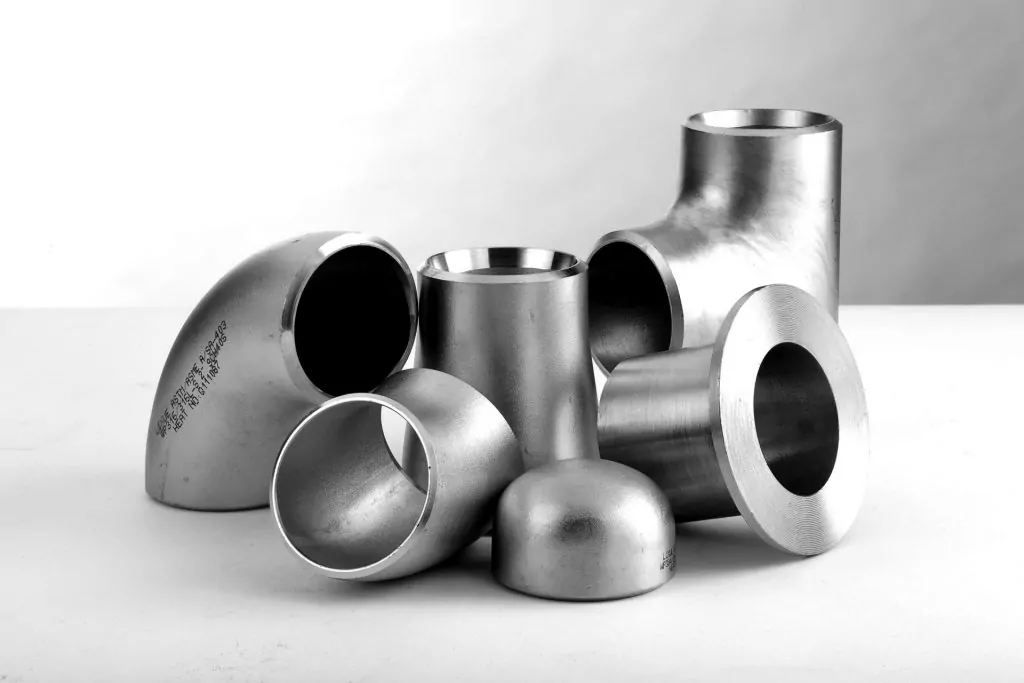
For procurement engineers sourcing pipe fittings in the UAE, understanding the difference between butt weld, socket weld, and threaded fittings — and the relevant ASME standards — is critical for correct specification, project compliance, and avoiding costly mistakes.
In the demanding oil & gas, petrochemical, and power sectors across Abu Dhabi, Dubai, and Sharjah, choosing the right types of pipe fittings ensures system integrity under high pressure, temperature, and corrosive conditions. This pipe fittings guide from Naftaar explains everything you need to know.
What are Pipe Fittings?
Pipe fittings are components used to connect, redirect, branch, or terminate piping systems. They play a vital role in maintaining flow efficiency, pressure integrity, and leak-free performance in industrial pipelines.
Whether joining two pipes of the same or different diameters, changing direction, or providing branch connections, fittings must match the pipe’s material, pressure rating, and service conditions. Common applications in the UAE include ADNOC projects, refineries, desalination plants, and process piping.
There are three primary connection types:
– Butt Weld (BW): Permanent, high-strength welded joints
– Socket Weld (SW): Fillet-welded for smaller diameters
– Threaded (THD): Screwed connections for easy installation/dismantling
Selecting the correct type impacts cost, installation time, maintenance, and safety. This pipe fittings guide breaks down each category in detail.
Types of Butt Weld Fittings – ASME B16.9
Butt weld fittings (governed by ASME B16.9) are the most common choice for high-pressure, large-diameter piping systems. They are factory-made from seamless or welded pipe, plate, or forgings and joined by full-penetration butt welding.
Key Types Include:
– Elbows: 90° and 45° in Long Radius (LR – 1.5D) and Short Radius (SR – 1D). LR elbows minimise pressure drop and are preferred in most process lines.
– Tees: Equal and Reducing Tees for branching.
– Reducers: Concentric and Eccentric for changing pipe diameter.
– Caps: For terminating pipe ends.
– Crosses, Stub Ends, and Laterals.
Advantages of Butt Weld Fittings:
– Strongest joint type with no leakage risk
– Smooth internal surface for better flow
– Suitable for high pressure and temperature
– Full range of sizes from 1/2” to 48” NPS
Butt weld fittings are ideal for critical service in UAE oil & gas projects.
Types of Forged Fittings – ASME B16.11
Forged fittings (covered under ASME B16.11) are manufactured from solid steel billets by forging and machining. They are used primarily for small-bore piping (NPS 1/8” to 4”).
Main Categories:
– Socket Weld Fittings: Insert pipe into the socket and fillet weld. Classes 3000, 6000, 9000.
– Threaded Fittings: NPT or BSP threads. Classes 2000, 3000, 6000.
Common Types:
– Elbows (90° & 45°)
– Tees (Equal & Reducing)
– Couplings (Full & Half)
– Unions, Caps, Plugs, Bushings, Nipples
Butt weld vs forged fittings: Butt weld offers superior strength for larger pipes, while forged (socket/threaded) are preferred for compact spaces, instrument lines, and easy maintenance.
Flanged Fittings – How They Differ from Butt Weld
Flanged fittings use bolted connections with gaskets, making them easier to disassemble for maintenance compared to butt weld fittings.
They are often used in combination with weld neck, slip-on, socket weld, or threaded flanges (ASME B16.5). Flanged systems are common in applications requiring frequent inspection or where welding is not feasible on-site.
Key Differences from Butt Weld:
– Easier installation and removal
– Slightly lower pressure ratings in some cases
– Higher cost due to flanges and bolts
– Better for temporary or modular piping
Material Grades for Pipe Fittings
Material selection must match the pipe and service environment:
– Carbon Steel: ASTM A234 WPB / WPC – Most common for general service.
– Alloy Steel: ASTM A234 WP5, WP9, WP11, WP22, WP91 – High-temperature applications.
– Stainless Steel: ASTM A403 WP304/304L, WP316/316L – Corrosion resistance.
– Duplex & Super Duplex: ASTM A815 – For sour service and offshore.
– Low-Temperature: ASTM A420 WPL6.
Always ensure NACE MR0175 compliance for sour gas applications common in the UAE.
Key Standards for Pipe Fittings
– ASME B16.9: Factory-made wrought butt-welding fittings.
– ASME B16.11: Forged steel socket-weld and threaded fittings.
– ASTM A234: Carbon and alloy steel butt-weld fittings.
– ASTM A403: Austenitic stainless steel fittings.
– ASTM A182: Forged stainless and alloy steel fittings for high temperature.
– Additional: MSS SP-75, MSS SP-43, ASME B16.5 (flanges).
All certified fittings from Naftaar come with full 3.1 MTCs and traceability.
How to Read a Pipe Fitting Specification – Worked Example
A typical specification looks like this:
“ASME B16.9 ASTM A234 WPB 6” SCH 40 90° LR Elbow”
Breakdown:
– ASME B16.9 → Standard (Butt Weld)
– ASTM A234 WPB → Material Grade (Carbon Steel)
– 6” → Nominal Pipe Size
– SCH 40 → Wall Thickness
– 90° LR Elbow → Type and Radius
Always cross-check with project P&ID, material specifications, and design conditions. Mis-specification is a frequent cause of project delays.
Why Choose Naftaar International FZE for Pipe Fittings in UAE?
As a leading supplier in the UAE, Naftaar International FZE stocks a comprehensive range of certified butt-weld and forged pipe fittings with immediate availability and fast delivery across the Emirates.
We provide full documentation, competitive pricing, and technical support for your next project.
Ready to source high-quality pipe fittings?
Contact Naftaar International FZE today for competitive quotes, technical datasheets, and expert consultation.
Naftaar International FZE – Your Trusted Pipe Fittings Supplier in UAE