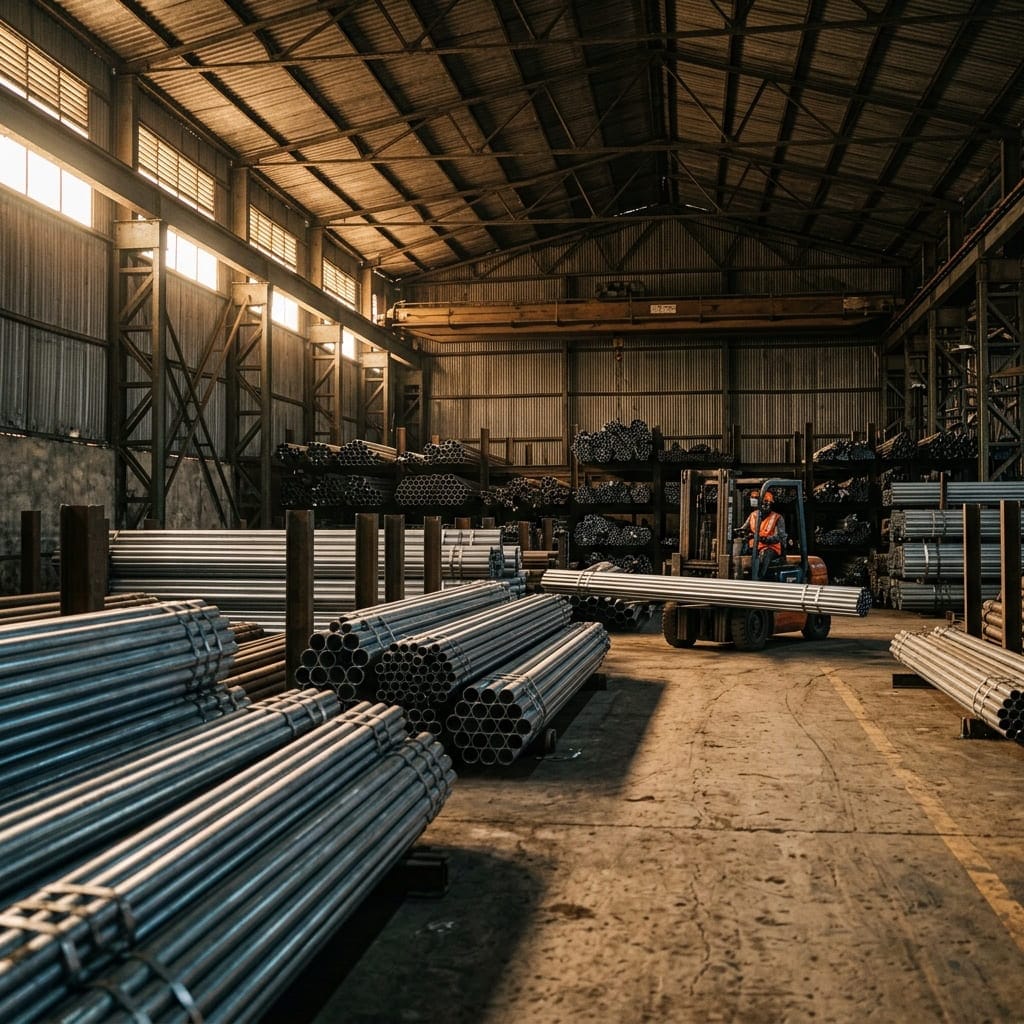
The GCC energy sector enters 2026 with one of the strongest project pipelines in recent years. ADNOC’s planned AED 200 billion (approximately USD 55 billion) in awards through 2028, Saudi Aramco’s multi-phase Jafurah unconventional gas development, QatarEnergy’s North Field Production Sustainability packages, and related offshore expansions are driving sustained demand for certified pipes, flanges, fittings, valves, and complete piping packages.
This activity is concentrated in upstream sour-gas developments, midstream pipeline capacity, gas processing, and downstream utilities. At the same time, global supply chains face structural pressure: extended mill lead times for specialty grades, geopolitical shipping disruptions affecting routes through the Strait of Hormuz and Red Sea corridors, and tighter availability of fully documented, NACE-compliant materials. For EPC contractors and operators, the critical path is no longer just engineering design—it is reliable, on-time delivery of the right piping materials.
This article examines the 2026 procurement landscape, the materials most in demand, practical strategies for mitigating lead-time risk, and why a UAE Free Trade Zone stockist model offers a distinct advantage for projects across the region and beyond.
The 2026 Demand Profile: Where the Orders Are Concentrated
Recent analysis of UAE oil and gas CAPEX points to clear material priorities for the coming quarters. Carbon steel remains the volume backbone (roughly 45% of demand in key programmes), particularly ASTM A105/A350 LF2 flanges and fittings for utilities and low-pressure systems, and ASTM A106 Grade B seamless pipe for process and pipeline service. Stainless steel (A182 F316L) accounts for a significant share of coastal, firewater, seawater, and amine systems. Alloy steel (A182 F22 and similar) serves high-temperature sour and heavy-oil circuits, while duplex and super duplex (F51/F53) and nickel alloys (Inconel 625, Incoloy 825) are specified for ultra-sour and high-chloride environments.
Sour-gas projects such as ADNOC’s Ghasha expansions and Aramco’s Jafurah phases impose the strictest requirements. Partial pressures of H₂S well above conventional thresholds drive NACE MR0175/ISO 15156 compliance, hardness control, and, in many streams, CRA or CRA-clad construction. These specifications lengthen both mill production and third-party inspection cycles.
Large-diameter API 5L line pipe (especially LSAW/DSAW in X60–X80 PSL2) continues to support midstream and export infrastructure, including capacity expansions that improve routing options away from congested maritime chokepoints. Valve packages—gate, ball, check, and specialised sour-service designs—remain long-lead items, particularly in higher pressure classes and exotic alloys.
The Lead-Time Reality in 2026
UAE warehouse stock for standard carbon-steel items (A105 Class 150–900 flanges, common A234 WPB fittings, A106 Gr B pipe in popular sizes) typically supports 2–4 week delivery. Stainless and low-alloy grades move into the 3–8 week range depending on size and class. Duplex and nickel-alloy components frequently require 8–20 weeks once mill capacity is booked, with non-standard bores or RTJ facing adding further time.
These figures assume stable logistics. Shipping disruptions, insurance premiums, and container imbalances can add weeks. For EPC schedules measured in months rather than years, the difference between “available from stock” and “mill order with inspection” determines whether a construction package stays on the critical path.
Procurement Strategies That Reduce Risk
1. Early engagement and dual-path sourcing
Identify long-lead exotic items at the MTO stage and place protective mill orders or capacity reservations in parallel with competitive bidding for standard materials. Many successful teams maintain a dual-track approach: stockist supply for the bulk of carbon-steel and common stainless items, and mill-direct for critical alloys.
2. Ready-stock and project-package models
A single-source project package—pipes, butt-weld and forged fittings, flanges, gaskets, and associated valves delivered against a coordinated schedule—reduces interface risk and documentation overhead. UAE Free Trade Zone stockists can hold common grades under duty-free conditions and release against release notes or call-offs, smoothing cash flow and site logistics.
3. Full traceability and inspection discipline
Every shipment must carry original EN 10204 3.1 (or 3.2) mill test certificates, heat-number traceability, and, where specified, third-party inspection reports. Pre-shipment PMI, dimensional checks, and NACE hardness verification prevent costly site rejections. Digital RFQ and documentation platforms accelerate this process without sacrificing control.
4. Specification optimisation without compromising integrity
Where project specifications allow, standardising on readily available grades and schedules (for example, common ASME B16.5 Class 150/300/600 raised-face flanges in A105N) can pull items out of the long-lead category. Technical advisory support from the supplier helps identify such opportunities early.
5. Logistics from a strategic hub
The UAQ Free Trade Zone location provides tax-efficient stockholding, rapid access to Jebel Ali Port, and established sea, air, and GCC road corridors. This combination supports both urgent air-freight of critical spares and cost-effective bulk sea shipments to Africa, Asia, Europe, and the Americas.
How a UAE-Based Stockist Supports Execution
Naftaar International FZE operates from the UAQ Free Trade Zone as a specialist stockist and global supplier of carbon steel, stainless steel, alloy steel, duplex, and higher-grade piping materials. The inventory covers API 5L and ASTM A106/A53/A333/A335 pipes, ASME B16.9 and B16.11 fittings, ASME B16.5/B16.47 flanges, industrial valves, and complete project packages—all supplied with full mill certification and traceability.
The model is designed for the realities of 2026 procurement:
– Ready stock of high-turnover carbon-steel and stainless items for rapid response.
– Access to a qualified global mill network for specialty and large-diameter requirements.
– Coordinated project-package supply with scheduled releases.
– Third-party inspection coordination and digital documentation.
– Technical support on material selection, NACE compliance, and specification alignment.
– Global logistics from a duty-free, strategically located hub serving more than 100 countries.
For EPC contractors working under ADNOC, Aramco, QatarEnergy, PDO, or international operators, this combination shortens the gap between purchase order and site readiness while maintaining the quality and documentation standards the industry demands.
Practical Next Steps for Procurement Teams
– Review open MTOs against current stock availability and typical lead times for each material group.
– Flag any duplex, alloy, or nickel-alloy items with delivery windows inside 12–16 weeks and initiate early dialogue.
– Consider consolidating bulk carbon-steel and common stainless requirements into a single project package to reduce administrative load and improve schedule certainty.
– Build 4–6 week logistics buffers into European- or Asian-origin specialty material schedules until shipping corridors fully normalise.
– Engage suppliers who can demonstrate both warehouse inventory and proven mill relationships, rather than pure trading intermediaries.
The volume of sanctioned and near-sanctioned work in the GCC means competition for mill capacity and certified inventory will remain intense through 2026 and into 2027. Teams that treat piping-material availability as a core project risk—and that partner with stockists capable of bridging the gap between mill production and site need—will protect their construction schedules and reduce the probability of costly delays.
Naftaar International FZE is ready to support your next RFQ. Submit your material requisition with specifications, quantities, and required delivery window. You will receive a competitive quotation with full certification details and a realistic delivery plan, typically within 48 hours.
Contact: sales@naftaar.com | +971 58 186 5535
Headquarters: Al Shmookh Business Centre, One UAQ, UAQ Free Trade Zone, Umm Al Quwain, UAE
Secure the materials that keep your project moving.