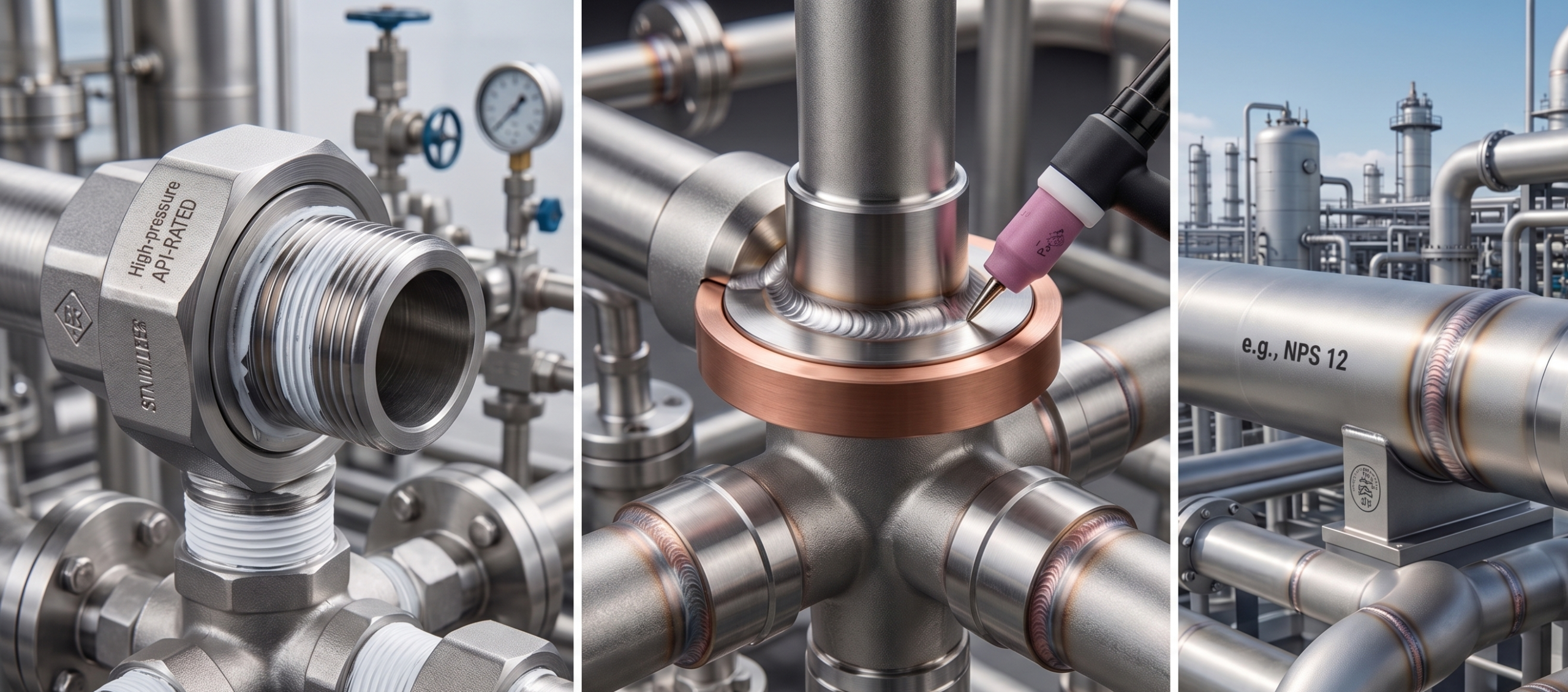
In oil & gas piping systems, the method used to connect pipes, valves, and fittings directly impacts safety, installation speed, maintenance, and long-term reliability. Choosing between butt weld vs socket weld vs threaded connections is one of the most important decisions during design and procurement.
Wrong selection can lead to leaks, increased maintenance costs, or even catastrophic failures under pressure. This comprehensive guide explains the differences, advantages, limitations, and best applications for each connection type — helping engineers and procurement teams make informed choices for projects worldwide.
At Naftaar International FZE, we supply pipes, fittings, and valves with all three connection types, backed by full material traceability and international certifications.
What Are the Main Connection Types in Piping Systems?
Piping connections are broadly classified into three categories based on how the joint is made:
1. Butt Weld (BW) — Permanent welded joint where pipe ends are beveled and welded together.
2. Socket Weld (SW) — Pipe is inserted into a recessed fitting and fillet welded.
3. Threaded (THD) — Screwed connections using NPT or BSP threads.
Each type has distinct mechanical properties, installation requirements, and suitability for different service conditions. Understanding these differences is essential for compliance with codes like ASME B31.3 (Process Piping) and project specifications.
Butt Weld Connections – ASME B16.9
Butt weld fittings are the gold standard for permanent, high-integrity joints in critical piping systems. The pipe and fitting ends are beveled (usually 37.5°), aligned, and joined by full-penetration welding.
Key Advantages:
– Highest strength and leak resistance
– Smooth internal bore for minimal pressure drop and turbulence
– Excellent for high-pressure, high-temperature, and cyclic service
– Full range of sizes from 1/2” to 48” and beyond
Limitations:
– Requires skilled welders and post-weld heat treatment in many cases
– Not suitable for frequent dismantling
– Higher installation time and cost
Best Applications:
– Main process lines in refineries and petrochemical plants
– High-pressure gas transmission
– Offshore platforms and subsea pipelines
– Critical safety systems
Butt weld is the preferred choice for the majority of main piping in oil & gas facilities due to its superior integrity.
Socket Weld Connections – ASME B16.11
Socket weld fittings feature a recessed area where the pipe is inserted before a fillet weld is applied around the outside.
Key Advantages:
– Easier alignment and faster installation than butt weld
– Good for small-bore piping (typically NPS 1/2” to 4”)
– Stronger than threaded connections
– Less sensitive to pipe wall thickness variations
Limitations:
– Crevice between pipe and socket can promote corrosion in certain services
– Not recommended for extreme cyclic or high-pressure service without careful design
– Fillet weld has lower fatigue strength than butt weld
Best Applications:
– Instrument lines and small-bore branches
– Utility and non-critical process lines
– Systems where welding is preferred but butt weld is impractical
Socket weld offers a good balance between strength and ease of installation for many auxiliary systems.
Threaded Connections
Threaded fittings use tapered threads (usually NPT – National Pipe Thread) to create a mechanical seal, often supplemented with thread sealant or PTFE tape.
Key Advantages:
– Easiest and fastest installation — no welding required
– Ideal for low-pressure systems and frequent maintenance
– Can be disassembled without cutting pipe
Limitations:
– Lower pressure and temperature ratings
– Threads can be a point of leakage or corrosion initiation
– Not suitable for cyclic loading or vibration-prone services
– Risk of galling in stainless steel threads
Best Applications:
– Instrument air and utility lines
– Low-pressure chemical injection
– Temporary or portable piping systems
– Areas where welding is prohibited (e.g., explosive atmospheres during shutdowns)
Threaded connections are common in auxiliary and low-risk systems.
Direct Comparison: Butt Weld vs Socket Weld vs Threaded
Strength & Pressure Rating: Butt weld > Socket weld > Threaded
Installation Speed: Threaded > Socket weld > Butt weld
Leak Resistance: Butt weld > Socket weld > Threaded
Maintenance & Dismantling: Threaded > Socket weld > Butt weld
Cost (Small Bore): Threaded is cheapest, followed by socket weld
Suitability for Sour Service / Corrosive Media: Butt weld is preferred; socket weld has crevice concerns; threaded is generally avoided
Fatigue Resistance: Butt weld is significantly better for cyclic service
Factors to Consider When Choosing Connection Types
1. Design Pressure and Temperature — Higher values generally require butt weld.
2. Fluid Service — Sour, corrosive, or high-purity services favor butt weld.
3. Pipe Size — Small bore (<2”) often uses socket weld or threaded; larger sizes use butt weld.
4. Maintenance Requirements — Threaded for easy access.
5. Project Location — Offshore or remote sites may prefer welded joints for reliability.
6. Code & Client Specifications — Many operators mandate butt weld for main process lines.
Always refer to the project Piping Material Specification (PMS) as the primary reference.
Welding and Fabrication Best Practices
For butt weld and socket weld systems:
– Proper beveling and alignment are critical
– Use qualified weld procedures (WPS/PQR)
– Post-weld heat treatment as per code
– 100% NDT for critical lines (radiography, ultrasonic, or magnetic particle testing)
Naftaar supplies pre-fabricated spools and can coordinate with approved fabricators for complex assemblies.
Naftaar International FZE – Your Global Piping Connection Partner
Whether you need butt weld fittings for high-pressure gas lines, socket weld for instrument connections, or threaded valves for utility systems, Naftaar International FZE offers a complete range with full international certifications.
We support projects worldwide with:
– Extensive stock of carbon steel, stainless, duplex, and alloy fittings
– Fast global shipping capabilities
– Technical expertise in material and connection selection
– Competitive pricing and reliable delivery
Need expert advice on butt weld vs socket weld vs threaded connections for your project?
Contact Naftaar International FZE today for technical consultation, material recommendations, and competitive quotations.
Contact Us | Naftaar International FZE – Complete Piping Solutions Provider